Letter from a vagabond 16 October 2018 Thoughts from Omaha Beach…

October 17, 2018

IMG_3847

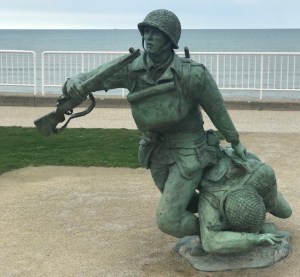
Two days ago, I booked myself on a tour that took me to Pont du Hoc, the American Cemetery and Omaha Beach.  Because I was in a group, it was a very different emotional experience than Verdun, where I was alone.  The group buffered the pain all of us were feeling, I think.

It was all Americans with one Danish couple.

The tour was led by Mike, who sounded all too British and turned out to be Dutch who had lived in England for a long time, lured to France to work three years ago with a start-up, Bayeux Multi-Media Tours, the company I booked.  The drive to Pont du Hoc was illustrated by a video shown on a flat screen above Mike, as he drove.  When it wasn’t on, he filled the silence with stories.

There were two high school best friends who every five years or so, created a trip just for themselves.  One is a College Dean, the other works in construction.  They live in different parts of America.  One couple was from Albuquerque and another from Philadelphia.  A young woman was from San Francisco, on a side trip before meeting friends in Rennes and then heading on to St. Malo.   We chatted about that.  Riding shotgun so he could charge his phone was Phil, from Chicago.  There were a few others.

We hear about Omaha Beach and know of the American Cemetery but I had never heard of Pont du Hoc, or if I had, had forgotten – which is a shame because this is where it really began, the first place the Allies began to claw back Europe from the Germans.

The Allies thought there were big guns, capable of firing three miles, captured from the French at Pont du Hoc. The Germans moved them away into a field, disguised them and replaced them with their own guns while leaving wooden decoys to confuse the Allies.  The Brits or Americans would bomb Pont du Hoc and never seemed to hit the guns so on D-Day, a group of Rangers were assigned to take out the guns at Pont du Hoc.  Of the 750 Rangers dispatched, only 225 ever reached Pont Du Hoc.

Under the command of Lt. Colonel James Earl Rugger, those 225 men took Pont du Hoc, secured it and took command of the road, cutting the Germans off.  For forty-eight hours, they held their own and when reinforcements arrived, only 90 were still capable of holding a gun.

In the bunkers the Germans built, I stood looking out the slits and wondered how terrified I would be if I had been a young German soldier waiting for the invasion they knew would be coming.

The Desert Fox, Rommel designed the defenses and would have been commanding the Germans if Hitler hadn’t ordered him to commit suicide because he was suspected of being part of the plot to kill Hitler.

At Pont du Hoc, I stood, alone, looking down at the cliffs the Rangers climbed and nearly doubled over in tears and wonder at the courage of those men.

We arrived at the American Cemetery just as they were lowering the flag.  Taps played, guns were fired as I stared across close to ten thousand graves.  Looking down upon the water, seagulls called, and the waves sounded.  Had it been that serene in the days before D-Day?

The landing at Omaha Beach appeared catastrophic.  As evacuation was being ordered, and a brash American battleship commander ignored the order, plowed his ship forward, turned on a dime, it seemed, and began to barrage the defenders with broadsides.  Four more ships followed, and the tide began to turn.

As I stood on the beach, a young man filled an empty Perrier bottle with sand.  Had his grandfather fought there?  He wandered off, his bottled sand in his knapsack.  Phil from Chicago fought back tears.

Staring out at the water, I felt enormous aloneness and a sense I was standing in history, even as a little girl ran down the beach, her arms flung wide, her blonde air streaming in the wind.


Letter from a vagabond 16 October 2018 Conversations happen…

October 16, 2018

IMG_3813

As it happens when traveling, conversations happen.

One of my favorite memories of my first trip to Europe, lo these many years ago, was eating by myself in a restaurant – London, I think, when the people next to me, also young though older than my college self, struck up a conversation with me.  They were from somewhere in America; I have never seen them again and I can still hear her laugh.

Other trips have brought other, similar memories.

My first night in Bayeux the young man who organized dinner seating in the restaurant at my hotel, cleverly sat me at a table adjacent to another man dining alone.  We started a conversation; his name is Eric, from Detroit, a lawyer in Grosse Pointe, actually, also traveling alone on a food odyssey before going to Wiesbaden to visit his cousins there.  His mother had been a German war bride, who, from what Eric says, is still annoyed at the Allies for their bombing.  His reminder that the Germans started the war has limited effect on her views, it seems.

In the bar the last night, I fearlessly struck up a conversation with some Brits, who were working their way back to England from a party in Burgundy.  Eric came in, joined us, and then Eric and I wandered off to one of the few restaurants open on a Monday.  He ate lightly as he had recreated a lunch that a writer had written about when he arrived as the town was liberated from the Germans.  A huge crab, frites, salad vert.  It sounded marvelous.

The Chicken Fricassee tickled my palate and was worth it, accompanied by a little muscadet and made a delightful dinner for me.  As I left the restaurant, I stopped and wished well to a couple from Philadelphia who had been on the Omaha Beach tour with me earlier.

Another set of Brits had arrived at the hotel bar when we returned and long conversations began and then I surrendered to my need to sleep, excused myself and went to bed.

As it happens, Eric will be in Wiesbaden when I am there; we have exchanged emails and he has offered to show me the town where he has spent goodly chunks of his life.


Letter from a vagabond 15 October 2018 Where the wind blows…

October 15, 2018

Outside the enormous windows of the train, the French countryside slips by, an ancient stone bridge connecting two parts of a village.  It is gray, with hopes the rain will relent by tomorrow – though it has mostly just drizzled when I have been outside.

Dawn was slow coming this morning and, for a moment, thought my phone was lying to me about the time.  Eventually, as I went down to settle my bill, light began to break across the square outside the hotel.  There, I waited for the taxi which took me to the train station.

It was only fifteen minutes to Pon de Bertagne, a ninety-minute wait for the train to Bayeux and two hours to reach there – a total of six stops between.

Fall is beginning to touch the trees, though that touch is surprising light.

I have now been in France for 11 days – Paris, Verdun, Metz, St. Malo and now Bayeux.  It has never been in my nature [ask my family] to hurry and I am not, hurrying thither and you to see this and that.

At one moment in St. Malo, I thought:  a tourist seeks, a traveler finds.  There is nothing I am seeking, and I am in hope of finding what it is I want to do when I return.  In each Cathedral I light a candle, asking for what good it is, I might still do in the remaining time.  Some kind of wind seems to be at my back.  I am hoping I will know when it blows me to where I belong.

Letter from a vagabond 13 October 2018 Teddy Bear Blues…

October 13, 2018

IMG_3742

October 10thwas NATIONAL BRING YOUR TEDDY BEAR TO WORK/SCHOOL DAY.  Yes, really.

If I were in doubt that I was going blog about my Verdun misadventure, that fact alone told me I must.

For those who know me well, it’s no secret I fight, all too frequently it seems, that thing Winston Churchill called “the black dog.” And in the spring of 2009, that old black dog and I were wrestling like there was no tomorrow. Confessing my struggle to a friend when on business in California, she sent me a teddy bear that had once belonged to her brother.  It is known as BearBear.

And he has been a constant in my life.

He’s a well-traveled bear – Costa Rica, most major American cities, the Caribbean, Italy, India, Martha’s Vineyard and, of course, he’s with me now.

Certainly, I know this opens me to a number of raised eyebrows and the confirmation of what many have suspected about my being eccentric.  However, I am told on good authority [I asked Google] that approximately 25% of men travel with their teddy bears. [Who knew?]

When I was a child, I don’t remember having a teddy bear or a binkie.  Maybe, that’s why he means so much to me now. He’s more worn now than he was – all that traveling will do it to you, you know. Just look at me.

If you read my last post, that important thing I left behind in Verdun?

BearBear.  I was sure I had double checked the room before I left and was sure I had BearBear in his place in my knapsack but, as I was on the bus to Metz from Verdun, I reached into my knapsack for something and realized there was no BearBear.

Terror struck my heart and my first impulse was to begin screaming for the bus to stop and turn around.  Calming myself, I did my best to be rational.

I remembered that reception at the hotel I had left was closed between 11 and 5 [I have no idea why].  Going on to Metz, I checked into my hotel, and waited eagerly for 5 and a chance to phone.

What if BearBear had run off to join les mousquetaires Francais de nounours? Or even worse, a thought I would not even entertain:  he had run off to join la Legion Etrangere des ours en peluche?

Patiently, I waited. 5 came and I phoned the number I found on the internet for the hotel, but the call would not go through.

“Your subscription does not support the call.”  Phoning AT&T, they assured me all was fine.  Calling the central hotel chain office in Paris, I kept repeating, “I’ve left something very valuable in Verdun,” in my best broken French.  The kind man connected me to Verdun and it seemed they had BearBear; however, I was not positive as my French, c’est horrible! And somewhere in the conversation I also had to convince him I was not trying to book a room for the following night [a good thing as they were sold out].

Unsure if they really had BearBear, I went out, asked a taxi driver to take me to a good restaurant [options limited on a Monday evening when most things are closed], ended going to the Bistro in the Citadel Hotel where I had an excellent meal of salmon rillettes, cod with lentils, followed by a cheese course, combined with a crisp demi-bouteille of Macon Villages.  When all else fails, good food and wine.

The only way to make it to the hotel when reception was open was to get up and take a 7:05 bus back to Verdun, which I did, getting up at four, wondering, praying, after not really sleeping anyway.

Reaching the hotel at 8:50 in the morning, I used iTranslate to ask the man at the counter if he had my teddy bear?  He brightened and raced to the baggage room and returned with a plush rabbit.

“Non! Non!”  My anguish was unmistakable.  He checked le placard de linge.  No BearBear. My distress was obvious.

Thankfully, he gathered all the staff, including the lovely young lady who had checked me in two days before.  They all awaited eagerly for the outcome of the adventure.

The housekeeper looked at me, smiling shyly, and went back into the linen closet, returned with BearBear and handed him to me.

My joy elicited laughs; they applauded, I nearly wept.  The woman who cleaned my room had, from what I could tell of what they said, recognized his bear magnificence and put him in a special spot, awaiting me.

My relief knew no bounds, my thanks unbridled.

Reunited, we have resumed our tour of Europe.


[Please blame any bad translations from English to French on my apps!]

Letter from a vagabond… Some pictures of St. Malo…

October 13, 2018

IMG_3789 2

Looking at the town from the walls surrounding it.

IMG_3791

Robert Surcoff, the famous Corsair/pirate.

IMG_3796

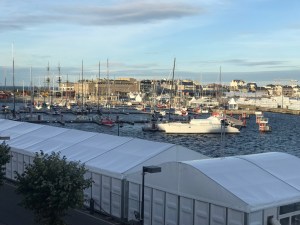
Sailboats at rest…

IMG_3797

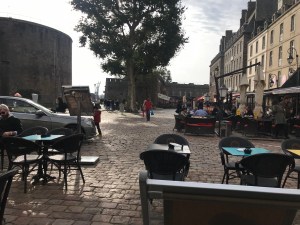
Cafes lining a street…

IMG_3799

The square in front of the Hotel France et Chateaubriand.

IMG_3793

Jacques Cartier, who sailed from St. Malo to discover and found Quebec.

Letter from a vagabond 11 October 2018 Thoughts on Verdun…

October 11, 2018

IMG_3731

Outside, heavy fog curls around our train as I speed on the TGV back to Paris, arriving at Paris Est. I have two hours to make my way to Paris Montparnasse to board another TGV to St. Malo, close to the border of Normandy and Brittany and I will stay there for a few days, four or five.  St. Malo has been on a list of places to see since I read, “All the Light We Cannot See” by Anthony Doerr, a best seller from two years ago, when I first worked in the bookstore.  If you have not read this World War II story, I recommend it.  It is one of those great reads, remaining with you long after the covers have been closed for the last time.

In Verdun, I spent two days at the Verdun War Memorial and at the Ossuary, the resting place of the bones of 100,000 men, who died in that battle, gathered together in one huge Art Deco building designed in the 1930’s.

It was not my intention to spend two days there.  And it was meant to be.  The first, and only day, I was going to be in Verdun, I spent so much time at the War Memorial I could not get to the Ossuary.  Regretfully, I left the next morning, only to discover I had left something very valuable behind.

So, I returned to retrieve it and took the time to go to the Ossuary, for which I am forever grateful.

The War Memorial lays out the life of horrors the men of Verdun, on both sides, endured.  It demonstrated how they attempted to maintain humanity in inhuman conditions.  They were known as “men of mud” because that is what they lived in, unremitting mud, day in and day out, for months on end, a battle that went on for more than 300 days.  300,000 soldiers, on both sides, died; another 700,000 were wounded, in a battle that decided nothing.  Officially France won the day, and, at the end of the day, it did nothing to move the fate of the war one way or another.  It destroyed Verdun, obliterated Fleury, left widows and sweethearts with dead lovers, mothers and fathers without children, children without fathers.

One letter read something like this: Mother, how could you let me be born into a world that might let me die like this?

It was found on his body later in the day that he had written those words.

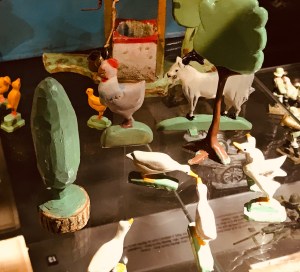
Every week, Charles Grauss carved a toy for his daughter, Ghislaine.  They are part of a beautiful collection at the museum.  He did not live to return to see Ghislaine appreciate his gifts; he never saw his daughter after he left for Verdun.

IMG_3704

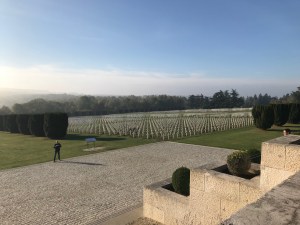
The Ossuary is a silent temple to the dead, silence that seems to pulsate.  To step outside and look across the fields where the armies fought, and hundreds of thousands died, is to, today, to see one of the most beautiful vistas on the planet, a valley, green and verdant, marked with rows upon rows of white crosses, stretching from one side to the other, marking the graves of men who could be identified.  Trees and grass have returned to a land some thought would be forever war destroyed.

The long upper hall of the Ossuary is bathed in a red orange glow from panes of colored glass; the light evokes both the blood shed on the fields below and the hope of heaven that must have been in the minds of men as they clawed through the mud of earth.

IMG_3729

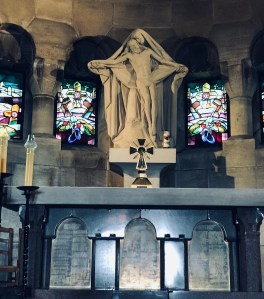
Catholics from France, Belgium, Switzerland, Canada and the United States all collected money to build a chapel on the second level.  Above the altar is a statue of Christ after being lifted down from the cross, agony ended by death.  It seemed a fitting statue for this somber place where agony often ended only in death.

IMG_3733

After the Ossuary was open, both Germans and French stood in front of it in 1936, vowing to never let this happen again.

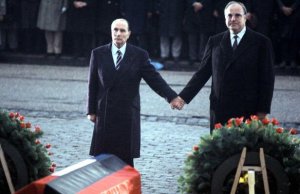
In 1984, the French President Mitterrand and the German Chancellor Kohl came together there.  Mitterrand had been captured by the Germans at Verdun in WWII.  Kohl’s father had fought in the hills during WWI.

They held hands a long time, a gesture of solidarity of what both sides had lost at Verdun, the best of a generation, a world that would never be the same, the seeds of an Allied victory having sowed the field that would become the next war.

M & K at V

Two men, at the beginning of the European experiment, acknowledging the hard road from Verdun in 1916 to that moment in 1984, hands clasped fiercely, the European experiment just beginning.

Letter from a vagabond 07 10 2018 Traveling to Verdun…

October 7, 2018

IMG_3690 2

Yesterday morning, I had a feeling of triumph – I successfully validated my Eurail Pass and made a seat reservation on the 10:40 TGV to Metz, where I transferred to a local train and made my way to Verdun, site of one of World War I’s greatest/worst battles.

The process was a little nerve wracking and I made it through with the help of Google Translate, my incredibly terrible French and the kindness of people who saw I was a baffled and, since I WAS trying, helped me manage with their far less terrible English.

By chance, I watched a man insert his ticket into a machine near where I was sitting and realized my ticket needed to be validated before I boarded, so I inserted mine also.  It says on the top, “BILLET a composter avant l’acces au train.” Loosely translated: Ticket composted [stamped?] before getting on the train.

The decision to go to Verdun was by chance.  One toss of the coin went to south, another to east; I looked at a map of France and to the southeast was Verdun, a recommendation of my friend David Arcara, who thought I would find it moving.

We left Paris, a Gallic fifteen minutes late, and raced through green farm fields.  As on farms in America, clusters of trees mark the placement of houses; little villages slide by in a moment as we travel at 312 kilometers per hour.  In a little over an hour, we arrived at Metz.

Last night, I had a delightful dinner with Pierre Alain Varreon, a friend of my friend Mary Ann Zimmer, at his favorite spot, Chez Paul, a vibrant place that winds through rooms and floors.  A set of repurposed subway doors from the 19th century, separates two of the rooms.  He drank red wine; I drank white.  We talked for hours and then I returned to the hotel, curled in bed, slept, woke early to face the gauntlet of validation.

It has been forty years since I have spent this much time in Europe.  Each moment reminds me to be watchful, in order to figure things out.  It is a foreign country – they do things differently here, large and small nuances.

Yesterday, I walked from my hotel to the Eiffel Tower.  Reaching it, I discovered it in now enclosed in double walls of bullet proof glass at the ground level, black bereted soldiers holding machine guns are all around.  One has to pass through security to go to the Tower.  Finding a bench facing the entrance, I remember a night, almost forty years ago to the day, when I and a half dozen plus Americans, stood beneath the Eiffel Tower at two in the morning and sang our tipsy version of “The Star-Spangled Banner,” to the amusement and disdain of a few lightly armed gendarmes.  That world is gone; it, too, is a foreign country.  They do things differently there as well, in the past.

Pierre Alain, who is a lifetime Parisian with long stints abroad, is thinking of moving to Portugal, where, I am told, all kinds of expats are finding their way.  Jim, who drove a bus during the summer on the Vineyard on my route, told me he is going to winter in Granada, Spain.

On now the second train of the day, a commuter from Metz to Verdun, I sailed past French towns.  Leaving the toilette, I held a door for an elderly lady and she was on the train with me.  She attempted to ask me a question and all I could do was indicate my French, c’est horrible!  She smiled and understood.

Bridges and underpasses were splashed with graffiti art, much as in the States.  In Paris, it seemed every available surface had been painted.  My amateur evaluation:  New York has better graffiti.


Letter from a vagabond… Paris, 04 October 2018 Klimt in light…

October 4, 2018

IMG_3687

After breakfast, I returned to my room and, feeling just a tad sleepy, lay down on my bed and took a nap.  Waking, I determined to go to the Atelier des Lumieres, where there was a program around Klimt, the painter of “Portrait of Adele Bloch-Bauer I” or, as it more famously known, “The Woman in Gold.”  It was the subject of a film of that name with Helen Mirren and Ryan Reynolds a few years ago, about Maria Altmann’s quest for repatriation of the painting.

This was not a viewing of the painting, which is in New York, at the Neue Galerie, where I saw it a year or so ago.  This was a light show to evoke all that went into Klimt’s paintings.  It began with images of Vienna before the Great War, when it was capital to empire, mixed with film footage of the ghosts of that time.

It was the kind of program, that were I a college student, I would wish to see in a slightly altered state.

Leaving, I wandered through parks and stumbled on the Church of St. Matthew, my patron saint, lighting a candle to be shown where I might do the most good in the time I am given.

Leaving there, I wandered through several parks, filled with children and parents, basking in the warm sun of the day, playing on phantasmagorical play devices, including a great spider web of ropes.  In one park, there was a high proportion of fathers caring for children.  They were watchful while on their cellphones.

Seeing that there was a subway which would take me back to my hotel, I figured it out and took the 9 back to La Muette, my stop, and came back to my hotel to change and go meet Chuck and Lois, who prepared a delightful white fish with a magnificent dill sauce, accompanied by a Puligny Montrachet, one of my favorite white wines.  We phoned our friend Larry and, then, before I overstayed my welcome, I slipped into an Uber and returned to the hotel.

Letter from a vagabond 04 October 2018 Breakfast in Paris…

October 4, 2018

CB6AB63C-5F1A-4928-BCAB-5E0FF1633EC5

In front of me is a narrow Parisian street; I am looking out at it through the windows of the restaurant attached to the Hotel Aero, where I am staying.  The attractive lady with the red scarf is having morning tea, with a little white dog comfortably settled out of sight at her side.

After taxiing in from Charles De Gaulle, I checked into my little hotel in the 16th on Place de Passy.  As I handed over my American passport, the gentleman behind the desk probed to see if I was a Trump supporter.  When I assured him I was not, he let loose with his not very high opinion of our American president.

Last night, I went over to the little Parisian apartment of my friends Chuck and Lois, which they are in the process of selling, as they, too, are thinking about what the next phase of their lives will be, how it will take shape.

We sat having cocktails avant le diner, when they shared with me they had come over on the Queen Mary 2.  Informing them I was sailing back on her, Lois asked, “When?”  As I said November 4th, she squealed, and Chuck guffawed.  Turns out they are on that on that crossing, too, and we will all be together.  It felt like a very 1930’s kind of moment.

We dined at one of their favorites, around the corner from them, Le Clocher du Village, a small sweet café where they are known and appreciated.  Lovely steak frites!

Chuck and Lois shared that their experience of Paris since Trump’s election.  The French love Americans but have only vitriol in their hearts for him.  And for most other politicians, including Macron.

Back to my hotel, off to sweet sleep and it was, waking to a sunny Parisian day, warm but not hot, life passing in front of me as I sit here, sipping my second café au lait.

Lois, Chuck and I have discussed going to the Musee de Orsay today.  I’ll check in when I finish this.  If not with them, perhaps on my own.  A day to be explored, enjoyed.


Letter from a vagabond… 03/10/2018 First day…

October 3, 2018

As I stare at the screen in front of me, I am 5 hours, 26 minutes out of Paris, having left New York two hours late due to storms raging through the region.  I am sipping a not bad white wine, ensconced in premium class on Norwegian Air, an upstart airline recently come to America after doing business as an intra-Europe air shuttle.

It’s not bad, not luxe but not bad.  The beef for dinner was quite good; the blanket provided is one of the best I’ve had on any flight, anywhere, in any class.  If there were another scrunch of room in my two bags, I would be tempted to depart the plane with it but there is not a scrunch of room in my two bags.

Most of my things are vacuum packed so that I could fit a wardrobe for five weeks in two bags, including my tuxedo and dress shoes for the crossing on the Queen Mary 2.

My great friend Larry Divney has named me “the vagabond” and so I am going to call these missives the Vagabond Letters, reports from the road as I traverse Europe, trying to decide what it is that I will be when I grow up.

And how exciting it is that I am still working out what it is that I will be when I grow up.  I’ve done many things, each one could have been the place I stopped and none of them have been.

The summer was glorious, a simple book seller in the magical kingdom of Edgartown on Martha’s Vineyard, though it didn’t feel simple.  It did feel good.

Watching the map in front of me, it seems that in a half an hour or so, we will have passed beyond North America and will be out over the Atlantic at 36,000 feet, headed straight into Charles De Gaulle in Paris.  The last time I was at CDG, I was walking next to Bo Derek and her husband/manager John Derek, now long, long gone.

It was a blurry moment, one of those times when it seemed every other day was another country, another set of people to meet with.  On that trip, not only did I see Bo Derek, I arrived in Paris while there was a strike on.  Who was striking and for what, I don’t know.  To get to my meeting I had to walk up 7 flights, through the strikers who were, at 9:30 in the morning, eating croissants and sipping champagne – a very civilized kind of strike, I must say.

This is five weeks when I have no real agenda except to wander where I will, when I will.  During the bookstore summer I read Nina George’s “The Little French Bistro,” which was one of the great life affirming books I have read. It is why I would like to visit Brittany, where the book is set.

A row or two in front of me, a man is asleep.  He snores for the ages.  Earlier, I thought he somehow had managed to get on the loudspeaker system, but it was just him.

It is the middle of the night, I am sleepy and will go to sleep. When I wake, we should be coasting into Paris.

When I have done all my other letters, I have done my best to be measured, thoughtful, concise, perhaps insightful.  These are going to be more free form, a stream of consciousness, notes from the road.  It is 2:35 AM in New York and 8:35 AM in Paris.

Good night from over the western Atlantic, 36,000 feet.